

A well-built custom lobby sign shapes a visitor’s first impression of your business. The material, lighting, and mounting method you choose determine how well it continues to look and perform over the long term. Offices that see the greatest return treat their lobby sign as infrastructure, not decoration.
This guide walks through the three decisions that drive lifespan and visual impact: which material to specify, which illumination type to choose, and how to mount the sign on your wall. It covers ADA compliance, Pacific Northwest conditions, realistic cost bands, and how to size the build to your lobby. By the end, you will know what to ask a sign partner before you sign a proposal.
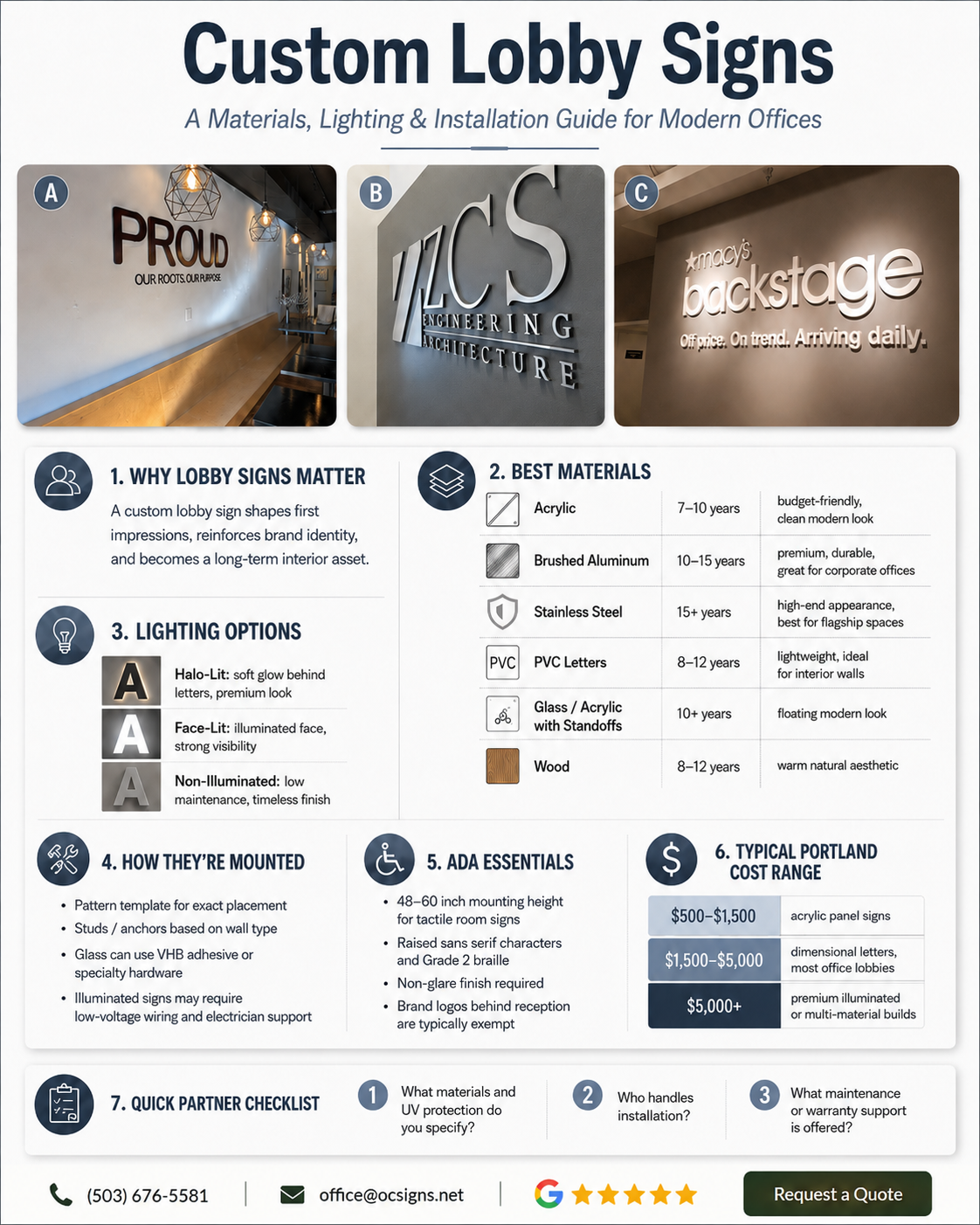
Before we break down materials, lighting, mounting, ADA rules, and cost ranges, here’s a quick visual overview of the key decisions that go into planning a custom lobby sign.
What Qualifies as a Custom Lobby Sign?
A custom lobby sign is signage designed, built, and fabricated to match a specific brand identity, wall, and lighting conditions, rather than selected from a stock catalog.
Custom means that the logo, letterforms, depth, material, finish, and mounting hardware are specified for a single space and a single brand. Off-the-shelf acrylic panels can work well on a budget, while fully custom builds give a corporate lobby the precision it needs to carry a brand with clarity.
The word “custom” earns its weight in three places: the art file, the build, and the install. Each of those decisions represents an investment in how the lobby reads to a visitor.
How Long Should a Well-Built Lobby Sign Last?
A properly specified custom lobby sign should last between 7 and 15 years in a typical office environment.
- Acrylic panels with UV-inhibiting face film hold roughly 7 to 10 years with no visible yellowing.
- Brushed aluminum and stainless steel dimensional letters hold 10 to 15 plus years.
- Illuminated builds depend on the LED driver: modern UL-listed drivers are rated for 50,000 hours, or roughly 10 years of commercial use.
Lifespan comes from three deliberate choices: a face material with the right UV rating, an adhesion system matched to the wall substrate, and quality electrical components on any illuminated build. Specifying all three thoughtfully keeps the sign looking sharp from year one through year ten.
Lobby Sign Materials Ranked by Lifespan and Use Case
Different materials carry different lifespans, costs, and visual characteristics. The decision matrix below reflects what is typically specified for commercial jobs across the Portland metro area.
- Brushed aluminum dimensional letters last 10 to 15 years, resist humidity, and feature a premium finish. Mid to high cost. Best for law firms, financial services, healthcare corporate offices, and any brand that needs to read as established.
- Stainless steel dimensional letters deliver a high-end look and a lifespan of over 15 years indoors. Highest cost. Best for flagship corporate headquarters, high-end retail HQ, and brands where the lobby itself is part of the pitch.
- Acrylic panel signs are the most common entry-level build: a flat or dimensional acrylic shape with printed or applied graphics. Lifespan of 7 to 10 years with a UV-rated face film. Low to mid cost. Best for small to mid-market offices, startups, and tenant branding in multifamily common areas.
- Dimensional PVC letters offer a lightweight build for interior use where weight matters. Lifespan of 8 to 12 years indoors. Mid cost. Best for tenant improvement projects on plenum ceilings or light-gauge drywall.
- Glass and acrylic with standoffs give a clean, modern, floating look. Lifespan of 10 plus years when mounted correctly. Mid to high cost. Best for tech, design, and creative brands that want the logo to feel layered on top of the wall rather than part of it.
- Wood lobby signs carry warmth and craft. Indoors in Oregon’s humidity, when sealed and mounted correctly, wood lasts 8 to 12 years. Mid cost. Best for wellness, hospitality, and brands that lean into a natural aesthetic.
Halo-Lit, Face-Lit, and Non-Illuminated Lobby Signs
- Halo-lit (back-lit) letters project a soft glow onto the wall behind each dimensional letter. The letter face stays dark. The effect is premium and modern, reading especially well in lobbies with controlled ambient lighting. Installation costs are higher due to LED placement and electrical work.
- Face-lit push-through letters push an illuminated acrylic face through a metal return, so the face glows, and the return holds the depth. The effect is better, more retail-forward, and reads better in high-ambient-light lobbies with glass walls. Mid to high install cost.
- Non-illuminated dimensional letters rely on ambient light and finish quality. The right material (brushed aluminum or polished stainless steel) makes this the most durable and low-maintenance option. Lowest cost of the three.
Energy matters, too. A modern halo-lit LED build draws roughly 15-40 watts. Over a decade of operation, that is a meaningful line item in a multi-tenant building.
How Dimensional Lobby Signs Get Mounted
Dimensional letters mount to a lobby wall through a pattern template, standoff studs, and the right anchor for the wall substrate. The process takes three to six hours for a typical corporate logo, and professional installation is the step that ensures everything stays exactly where it should for the long term.
A pattern template positions every letter precisely. Standoff studs hold dimensional letters either flush to the wall or at a specified reveal. Drywall walls use toggle or molly anchors rated for the letter weight. Masonry or concrete walls use sleeve or wedge anchors. Glass walls use VHB adhesive or custom clamp hardware designed for glass.
Illuminated builds add an electrical step. A UL-listed driver and low-voltage wiring run through the wall to each lit letter, typically requiring a licensed electrician and potentially involving permitting. Using UL-listed components keeps the installation aligned with standard commercial building insurance requirements.
ADA and Code Requirements You Cannot Skip
Lobby signs that name rooms, identify permanent spaces, or direct visitors fall under the 2010 ADA Standards §703. These guidelines are clear and straightforward to follow when planned.
Mounting height for tactile signs is 48 to 60 inches from the finished floor, measured to the baseline of the lowest tactile character. Tactile characters must be raised 1/32 inch, sans serif, and between 5/8 inch and 2 inches tall. Grade 2 braille is required beneath tactile characters on permanent room identification signs. Non-glare finishes are required on all tactile signs to maintain contrast for low-vision readers.
Brand logos mounted behind a reception desk are typically exempt from ADA tactile rules because they do not identify a permanent space. Room identification, suite numbers, and wayfinding signs are not exempt. Planning this split correctly early in the process helps tenant improvements move through sign-off smoothly.
Where to Place a Lobby Sign and at What Size
The sign belongs on the wall that a visitor sees first when the front door opens. In most corporate lobbies, that is the wall behind or beside the reception desk. A good rule is that the logo should occupy roughly 40 to 60 percent of the visible wall width at standard viewing distance.
Three variables influence the final placement: ceiling height, the position of HVAC registers and overhead light wash, and the presence of south-facing glass walls that bring afternoon UV onto the opposite wall. In Oregon, that afternoon light makes UV-rated acrylic or aluminum a smart specification choice for those wall locations.
What Custom Lobby Signs Cost in the Portland Metro
Custom lobby sign projects in the Portland metro fall into three directional cost bands. These are not quotes. They reflect typical ranges seen on real commercial jobs.
- $500 to $1,500 covers an acrylic panel sign, standard sizes, non-illuminated, mounted on drywall with standard anchors. Best for small offices, coworking suites, and tenant branding in shared common areas.
- $1,500 to $5,000 covers dimensional letters in brushed aluminum or PVC, halo-lit or non-illuminated, with custom art files and a professional install. This is the working range for most mid-market corporate lobbies.
- $5,000 and up covers stainless steel or multi-material builds, halo-lit or face-lit, custom hardware, and more involved installs like glass walls, masonry, or multi-location rollouts. This is the range for flagship offices, corporate headquarters, and multifamily brand rollouts across a portfolio.
Lead time from approved art to installed sign typically runs four to eight weeks. Illuminated buildings sit at the longer end of that window due to electrical coordination.
Pacific Northwest Factors: Humidity, Ambient Light, and South-Facing Glass
Oregon’s climate creates specific conditions that a well-planned lobby sign is designed to handle. Higher relative indoor humidity, common in buildings with older HVAC systems, means specifications for adhesive bonds and sealed wood finishes deserve extra attention. Specifying 3M VHB adhesives rated for interior humidity and adding mechanical studs to any letter over roughly six inches tall builds in long-term stability.
Ambient light is equally important. Portland and Oregon City lobbies experience lower average daylight than comparable lobbies in sunnier regions, which means halo-lit and face-lit builds do more visual work during overcast months. On south-facing glass lobbies, direct afternoon UV still reaches interior walls, so UV-rated acrylic face films remain a high-value specification in Oregon, even with comparatively less total annual sunlight.
How to Choose a Lobby Sign Partner in the Portland Metro
Three questions help identify a sign partner who will deliver long-term value.
- Ask what they specify for UV face protection on acrylic builds and what adhesive they use for dimensional letters on drywall. A knowledgeable partner will name the product and explain the reasoning.
- Ask who handles the installation. A dedicated partner either installs with their own crew or works with a consistent installation team, taking full ownership of the finished result.
- Ask what ongoing support looks like at year five. A partner relationship includes maintenance readiness and clear warranty terms that give you confidence in the years ahead.
A well-planned custom lobby sign is a 10-year asset, and the partner you choose should demonstrate full lifecycle ownership from consultation through long-term maintenance. OC Sign Group, a family-owned sign partner in the Portland metro since 2001, exemplifies this model by managing every stage of a project under one roof.
Ready to Plan Your Lobby Sign Project?
If you are evaluating lobby signs Portland businesses trust and want to work with a partner who manages every step from material selection through long-term maintenance, our team is here to help. We will walk through your wall, your lighting, and the brand impression you want visitors to take away from your lobby.
Reach out today to schedule a consultation.
Also Read: Lobby Signs in Portland: 9 Design Ideas for Offices
Frequently Asked Questions
How long does a custom lobby sign last?
A properly specified custom lobby sign lasts between 7 and 15 years. Acrylic panel signs with UV-rated face film hold 7 to 10 years. Brushed aluminum and stainless steel dimensional letters last 10 to 15 years. Lifespan comes from the face material, the adhesion system, and, for illuminated builds, the LED driver quality.
What is the difference between halo-lit and face-lit lobby signs?
Halo-lit dimensional letters have a dark face and glow onto the wall behind them, creating a soft, premium effect. Face-lit push-through letters have an illuminated acrylic face and a metal return, creating a better effect that holds up in high-ambient-light glass lobbies. Halo-lit typically costs more to install. Face-lit typically draws more power.
Do I need an ADA sign in my Oregon office lobby?
Your brand logo behind the reception is usually exempt. Any sign that identifies a permanent room (suite numbers, conference rooms, restrooms) is not exempt and must meet the 2010 ADA Standards §703: tactile raised characters, Grade 2 braille, mounting height between 48 and 60 inches, and a non-glare finish.
How much does a custom lobby sign cost in the Portland metro?
The cost of a custom lobby sign can vary significantly depending on factors such as size, materials, design complexity, illumination, and installation requirements. Simple lobby signs typically start around $500, while larger, more customized, or illuminated signs can range into the thousands. The best way to determine pricing is through a consultation, where we can recommend a solution that fits your space, branding, and budget.
How long does it take to design, make, and install a lobby sign?
Lead time from approved art to installed sign typically runs four to eight weeks. Non-illuminated builds sit at the shorter end. Illuminated buildings sit at the longer end because of electrical coordination and, in some cases, Oregon permitting.
Can a lobby sign be mounted on glass, or only on drywall?
Glass is an excellent surface for lobby signs when the correct hardware is used. It uses 3M VHB adhesive, custom clamp hardware, or edge-mounted standoffs rather than mechanical anchors. The key is to match the mounting system to the sign’s weight and material.