

Most businesses need signage that fits their space, represents their brand, and meets local requirements. From storefront signs to interior branding, the decisions made during planning affect how the final sign looks, how it performs over time, and how smoothly the project moves from design to installation.
Choosing a sign company involves more than selecting a design. It requires experience with materials, fabrication, and local regulations in cities such as Portland, Bend, and Salem.
Choosing the right Oregon sign company depends on experience, in-house capabilities, material quality, permitting expertise, and proven local results. This guide outlines the types of signs available, what to look for in a provider, and how to evaluate your options before moving forward.
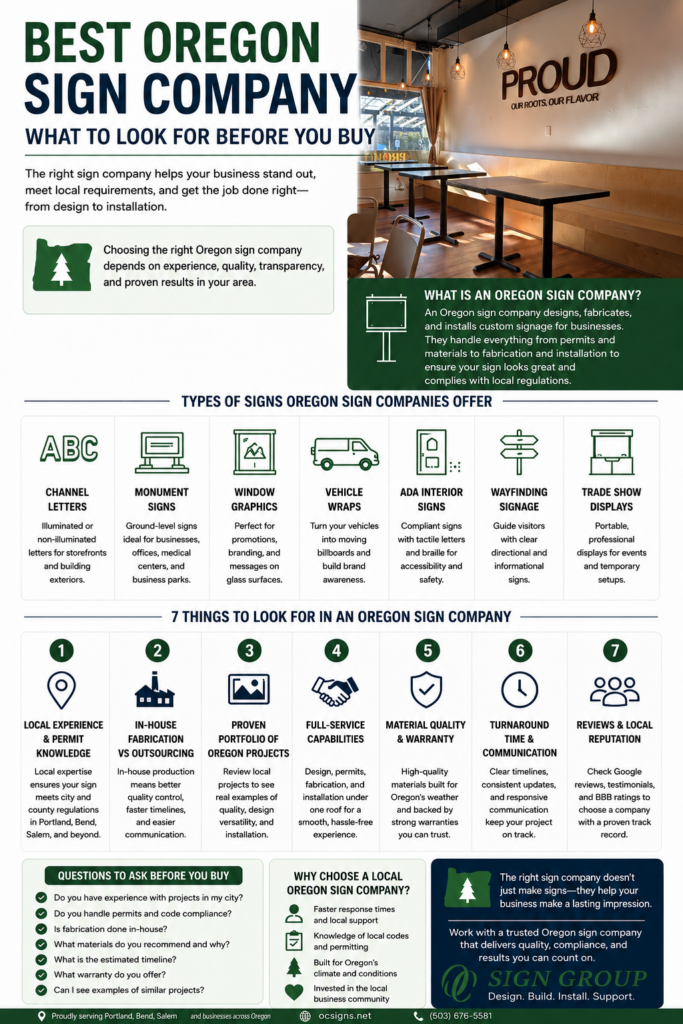
Here’s a quick visual guide to what businesses should look for before choosing an Oregon sign company.
What Is an Oregon Sign Company?
An Oregon sign company designs, fabricates, and installs business signage for commercial spaces. This includes exterior signs such as channel letters and monument signs, as well as interior signage like lobby signs, ADA-compliant signs, and wayfinding systems.
Most full-service sign companies also handle permitting, material selection, and installation to ensure the signage complies with local regulations and performs properly once installed.
What Types of Signs Do Oregon Sign Companies Offer?
Oregon sign companies provide a range of signage options depending on business type and location.
- Channel letter signs are individually fabricated letters, often illuminated, used for storefront visibility and building exteriors.
- Monument signs are ground-level structures placed near entrances or roadways and are commonly used for offices, medical centers, and business parks.
- Window graphics are used for temporary promotions or branding on glass surfaces and are easier to install and replace.
- Vehicle wraps apply branding to company vehicles and are commonly used by service-based businesses that operate across multiple locations.
- ADA interior signs are required for accessibility and include tactile lettering and braille for room identification and navigation.
- Wayfinding signage helps direct people within a building or property, including directional signs and suite identifiers.
- Trade show displays are portable signage systems designed for events and temporary setups.
7 Things to Look for in an Oregon Sign Company
Choosing the right partner requires evaluating more than pricing. In Oregon, signage projects often involve coordination with local regulations, material selection for changing weather conditions, and proper installation across different building types. The following factors influence how your signage is produced, installed, and maintained over time.
1. Local Experience and Oregon Permit Knowledge
Sign requirements vary across cities in Oregon. Regulations can include restrictions on size, placement, lighting, and materials, depending on the property’s location and type. A company with local experience understands how to design signage that meets these requirements from the outset.
This helps streamline the approval process and reduces the need for revisions. Local familiarity also helps when coordinating with city departments, landlords, and property managers, especially for projects that require multiple approvals.
2. In-House Fabrication vs Outsourcing
Some sign companies fabricate signage internally, while others rely on third-party production.
In-house fabrication allows for more direct oversight of materials, timelines, and quality. It also simplifies coordination, since the same team handles design and production.
Outsourcing can be suitable in some cases, but it may introduce additional steps and reduce visibility into how the sign is produced. When reviewing a company, it is useful to understand where fabrication takes place and how the process is managed.
3. Proven Portfolio of Oregon Projects
A portfolio provides a clear view of how a company’s work translates from concept to installation.
Examples of completed projects in Oregon can show how signage performs in different environments, including commercial buildings, retail spaces, and office interiors.
Looking at local work also helps you assess how the company handles installation across various surfaces and conditions.
4. Full-Service Capabilities
A full-service sign company manages design, fabrication, permitting, and installation within one workflow. This approach reduces the need to coordinate between multiple vendors and helps maintain consistency throughout the project. It also creates a more streamlined communication process, since one team is responsible for each stage.
For most businesses, working with a full-service provider simplifies planning and execution. At OC Sign Group, projects are managed from design through installation across Oregon, which helps maintain consistency in materials, timelines, and final results.
5. Material Quality and Warranty
Material selection plays a key role in how signage performs over time, particularly in Oregon’s climate, which includes moisture and varying temperatures.
Common materials include acrylic, aluminum, and vinyl, each suited to different applications. For example, aluminum is commonly used for exterior signage because it resists moisture, while vinyl is better suited for short-term or interior applications.
A reliable sign company will explain these differences and provide warranty coverage for both fabrication and installation so you understand how the sign is expected to perform over time.
6. Turnaround Time and Communication
Signage projects involve multiple steps, including design approval, production, and installation scheduling.
Clear timelines and consistent communication help keep the project on track. A designated point of contact can make it easier to coordinate approvals and address questions as they arise.
Understanding the expected timeline upfront helps set clear expectations for both sides.
7. Reviews and Local Reputation
Reviews and testimonials provide insight into how a company operates beyond its portfolio.
Feedback on project quality, communication, and reliability can help you understand what to expect in your own project.
Companies with strong local reputations and repeat clients often have established processes that support consistent results.
Oregon Sign Permits: What Your Sign Company Should Handle
Permits are required for many types of signage in Oregon, particularly exterior signs such as channel letters and monument signs. Each city has its own requirements for size, height, illumination, and placement that must be approved before fabrication and installation can begin.
Each city has its own set of requirements related to size, height, illumination, and placement. In addition to city regulations, some properties require approval from landlords or homeowners’ associations before installation can proceed.
A sign company should manage the permitting process as part of the project. This typically includes preparing drawings, submitting applications, and coordinating with local authorities.
If the company does not handle permitting, it can create additional steps for the client and extend the overall timeline. Permit approval timelines usually range from two to six weeks, depending on the location and complexity of the project.
How Much Do Business Signs Cost in Oregon?
The cost of business signage in Oregon varies based on the type of sign, materials, size, and installation requirements.
Smaller projects, such as vinyl banners or basic window graphics, are typically on the lower end of the cost range. Larger signs, such as channel letters or monument signs, require more fabrication time, materials, and installation labor, increasing the overall investment.
For example, a simple banner or window graphic may cost a few hundred dollars, while larger exterior signage projects can range into several thousand dollars, depending on size, lighting, and site conditions. Vehicle wraps also vary based on coverage, with partial wraps costing less than full wraps.
Because each project is different, most sign companies provide pricing after reviewing the location, design, and installation requirements to ensure the quote reflects the actual scope of work.
Questions to Ask Before Hiring an Oregon Sign Company
Before selecting a sign company, it helps to ask a few practical questions about how the project will be handled.
You can ask whether the company manages permits, whether fabrication is done in-house, and whether they can provide examples of completed projects in Oregon.
It is also useful to confirm the expected timelines, warranty coverage, and your main point of contact throughout the project. These questions provide a clearer understanding of how the company operates and what you can expect during the process.
Choosing an Oregon Sign Company That Delivers Long-Term Results
Choosing an Oregon sign company involves more than selecting a design or comparing prices. It requires understanding how the company approaches materials, fabrication, permitting, and installation, and how those decisions affect the final result.
Working with a local, full-service provider helps ensure that each stage is handled consistently, from initial design through final installation. This reduces delays, improves coordination, and results in signage that performs reliably over time.
If you are planning new signage or updating your current setup, the next step is to review your space, materials, and permit requirements early. You can request a consultation or get a quote to explore options that fit your business and location.
Frequently Asked Questions About Oregon Sign Companies
How do I find the best Oregon sign company near me?
Look for a sign company with local experience, a strong portfolio of Oregon-based projects, and consistent customer reviews. Full-service capabilities also simplify the process.
Do sign companies handle installation?
Yes, most sign companies handle installation to ensure signage is mounted correctly and meets safety and code requirements.
How long does it take to complete a sign project?
Timelines range from a few days to several weeks, depending on design, fabrication, and permit requirements.
What types of signs are most popular for businesses?
Channel letter signs, monument signs, and interior signage, such as lobby and wayfinding signs, are commonly used across industries.
Can a sign company help with branding and design?
Yes, many sign companies provide design services to translate branding into physical signage, including layout, materials, and placement.